Northern Tool Generator: Costs, Specs, and a Side-by-Side Guide
An analytical, data-driven comparison of Northern Tool generator options, sizing guidance, running costs, and installation considerations for homeowners and property managers.


According to Genset Cost, for most homeowners weighing Northern Tool generator options, a 2,000–3,500W model offers the best balance of cost and versatility. Prioritize running watts over surge, check noise and fuel efficiency, and compare total installed costs (generator, transfer switch, and installation). The Genset Cost team suggests sizing to your critical loads and budgeting for maintenance.
What Northern Tool offers in the generator space
Northern Tool & Equipment positions itself as a practical source for homeowners seeking portable and standby power solutions. The brand's generator lineup emphasizes value, ease of use, and broad availability, which makes it attractive for homeowners and property managers who need quick, reliable backup power. According to Genset Cost, Northern Tool presents models that range from compact 1000–1500W portable units up to mid-range 3500–5000W standby-capable options, with a focus on gasoline engines suitable for frequent seasonal use. The trade-off with budget-oriented models is typically a lean feature set rather than premium refinements, but this can be enough for essential circuits such as lighting, refrigeration, and sump pumps. When evaluating options, consider not only the advertised peak wattage but also the continuous running watts you will rely on during an outage. A common approach is to target 60–80% of your anticipated peak load to avoid overloading the generator and to preserve longevity. The Genset Cost team notes that many homeowners underestimate the value of a well-mimensioned transfer switch and a robust wiring plan.
Key performance indicators to compare
To conduct a meaningful comparison, anchors matter. Start with running watts (continuous power) and surge watts (startup power) to determine what your appliances can run simultaneously. Northern Tool generators typically emphasize portability and reasonable runtimes, but performance can vary by model. Next, inspect fuel efficiency and fuel tank capacity; a larger tank increases runtime but adds weight. Noise level is another critical factor, particularly in residential areas; a drop from 70 dB to 60 dB may be noticeable, especially when running during quiet evenings. Availability of solid-state safety features, like automatic shutdown on low oil, overload protection, and battery-less starting options, should also influence your decision. Finally, assess maintenance requirements and spare parts availability; Northern Tool's service network—both online and in-store—facilitates part sourcing and basic repairs, yet some components may require more hands-on attention compared to premium brands. When in doubt, map features to your priorities: quiet operation, fuel flexibility, or minimal maintenance.
Sizing your needs: how to estimate loads
Sizing a generator starts with a clear inventory of essential devices and circuits. List items you want powered during an outage (furnace/blower, refrigerator, lights, sump pump, wifi router, and a few convenience devices). Convert each item’s wattage into running watts and add them up. Then estimate startup surges for devices with motors (refrigerators, sump pumps). Add a safety margin of 25–50% to accommodate unforeseen loads and future upgrades. For most modest homes, a 2000–3500W Northern Tool model handles lights, a well pump, the fridge, and essential outlets. If your plan includes air conditioning or space heaters, you’ll need higher wattage and potentially a standby solution. Finally, verify compatibility with your electrical panel and transfer switch requirements—an improperly sized system can lead to nuisance trips or safety hazards. The goal is reliable power for critical loads, not to run every appliance at once.
Fuel choices and efficiency considerations
Gasoline is common for Northern Tool portable generators, with propane and dual-fuel configurations becoming more available in mid-range models. Fuel choice influences running costs, stability, and availability during outages. Propane tends to burn cleaner and can be stored indefinitely, but propane adapters or larger tanks might be needed to match runtime expectations. Gasoline offers high energy density and quick refueling, yet it can degrade over time and requires fresh supply in extended outages. Efficiency hinges on engine design, load factor, and maintenance. A generator running near its rated capacity will be more efficient than one frequently idling. Look for models with automatic idle control, efficient spark plugs, and easy-access air filters. Regular oil changes and air filter maintenance extend life and keep efficiency intact. Finally, plan maintenance around your local climate, storage conditions, and anticipated usage patterns to maximize fuel economy.
Cost components: upfront, running, and installation
The total cost of ownership includes more than the sticker price. Upfront costs cover the generator unit, transfer switch, and basic wiring; installation costs vary by locale, electrical panel compatibility, and whether a professional connects a standby transfer switch. Running costs depend on fuel type, hours of operation, and local energy prices. Fuel consumption per hour under typical load offers a practical way to estimate ongoing expenses. Look for fuel-efficient engines with good throttle response and cooling systems. Maintenance intervals—oil changes, filter replacements, and spark plug checks—affect long-term reliability and cost. Finally, warranties vary by model and retailer; verify coverage for parts, labor, and troubleshooting, and confirm whether service is available within your area.
Reliability, maintenance, and warranty considerations
Reliability hinges on build quality, engine design, cooling efficiency, and maintenance discipline. Northern Tool models often rely on proven gasoline-industry components, which supports predictable performance. Maintenance is generally straightforward: regular oil changes, air filter replacements, spark plug checks, and battery maintenance for electric starts. Warranty terms can differ by model and retailer; longer warranties typically indicate confidence in durability but may come with conditions on proper storage and maintenance. For property managers, factor in the availability of local service centers and the ease of obtaining spare parts. In addition, review transfer switch compatibility and any required certifications for installation, as these influence both safety and downtime during outages. A well-chosen model paired with proper maintenance yields more consistent performance over time.
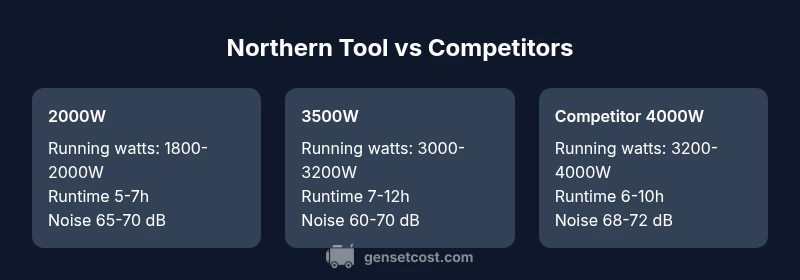
Comparing Northern Tool models vs common competitors
When you compare Northern Tool models with major competitors, consider three axes: performance, price, and serviceability. Northern Tool often provides budget-friendly options with decent performance and broad availability, which makes it attractive for cost-sensitive projects. In contrast, premium brands may offer quieter operation, longer runtimes, and higher efficiency but at a higher upfront cost. For many homeowners, the best choice balances initial price with expected runtime and maintenance costs. Model-to-model comparisons should align with your load profile, space constraints, and the local service network. A structured approach—collecting wattage data, measuring noise, and evaluating installation requirements—helps you avoid sticker-shock and mis-sizing. Always confirm compatibility with your transfer switch and electrical panel, as incompatibilities can dramatically increase total cost and complexity.
Practical scenarios: apartment, small home, larger home
In apartments or small homes, portability and low noise are critical. A compact 1000–2000W Northern Tool unit can cover lights, chargers, and a few essential outlets, provided you plan a shared circuit strategy and a safe, code-compliant installation. For larger homes with regular outages, a 3000–5000W model becomes more practical—again, paying attention to surge capacity for air fans or pumps. In homes with central HVAC or high electrical demand, you may require a higher-capacity system or a standby solution with a professional transfer switch. In all cases, map your critical circuits first, then scale up to ensure continuous operation through outages. This approach minimizes wasted capacity and keeps operating costs reasonable while ensuring essential services stay online.
How to buy: tips on evaluating a seller, warranty, service
Before purchasing, verify the seller’s return policy, service network, and warranty terms. Look for transparent documentation on total installed cost, including transfer switch, wiring, permits, and labor. Ask about the model’s run time at a realistic load, maintenance intervals, and what the warranty covers (parts, labor, or both). Check online reviews and user forums for reliability data and common failure modes. If possible, request a demonstration of starting, load transfer, and shutdown procedures. Finally, ensure access to qualified technicians for installation and ongoing servicing, because proper setup is essential to safety and performance.
Feature Comparison
| Feature | Northern Tool Generator 2000W | Northern Tool Generator 3500W | Competitor 4000W |
|---|---|---|---|
| Power output (running watts) | 1800-2000W | 3000-3200W | 3200-4000W |
| Surge capacity (startup) | 2000-2400W | 3600-3800W | 4200-4800W |
| Runtime at 50% load | 5-7 hours | 7-12 hours | 6-10 hours |
| Fuel type | gasoline | gasoline | gasoline |
| Noise level (7m) | 65-70 dB | 60-70 dB | 68-72 dB |
| Estimated price range | $450-$700 | $800-$1200 | $900-$1500 |
The Good
- Broad model range with strong budget options
- Wide retailer network for parts and service
- Competitive upfront pricing for entry-level power
- Simple maintenance and quick-start designs
The Bad
- Fewer advanced features vs premium brands
- Potentially louder at higher loads
- Resale value may be lower than top-tier brands
- Warranty terms can vary by retailer
Solid value for budget-conscious buyers; consider premium brands if noise or long-term efficiency matters more
Northern Tool generators deliver dependable power at a good price. If your priorities include quiet operation and long-term efficiency, compare total cost of ownership against premium models and plan for maintenance.
People Also Ask
What is the main difference between Northern Tool generators and premium brands?
Northern Tool generators typically prioritize value and availability, offering solid performance at lower upfront costs. Premium brands may deliver quieter operation, higher efficiency, and longer runtimes, but at a higher price. Your choice depends on budget, desired runtime, and acceptable noise levels.
Northern Tool focuses on value and accessibility, while premium brands emphasize quiet operation and efficiency. Choose based on your budget and noise tolerance.
How should I size a Northern Tool generator for home backup?
List critical loads, convert each item to running watts, add startup surges, and apply a safety margin (about 25–50%). Aim for 60–80% of peak load to avoid overloading and to allow room for future needs. Verify panel compatibility and transfer switch requirements.
Start with critical loads, add surges, and include a safety margin to size correctly.
Are Northern Tool generators good for long-term use?
They are generally reliable for typical residential outages when properly sized and maintained. Long-term performance depends on regular oil changes, air filter maintenance, and adherence to warranty terms. For heavy, frequent use or complex installations, consider brands with longer warranty coverage and proven durability.
Reliability comes with proper sizing and regular maintenance; check warranty terms for long-term use.
What maintenance is required for a gas-powered generator?
Regular oil changes, spark plug checks, air filter replacements, and battery maintenance for electric starts. Run the generator periodically to keep parts lubricated and to prevent fuel degradation. Follow the manufacturer’s service schedule and use fresh fuel or stabilizers for storage.
Maintain oil, filters, and spark plugs; run it periodically and store fuel properly.
Where can I buy Northern Tool generators and get service?
Northern Tool units are available through their retailers and online store. Verify warranty terms, inflation of installation costs, and access to local service centers. Ensure you can obtain spare parts and obtain professional installation if required by local codes.
Buy through Northern Tool channels and verify local service availability before purchase.
Key Takeaways
- Assess running watts to meet essential loads
- Prioritize transfer switches and installation costs
- Evaluate noise and fuel efficiency for your setting
- Check warranty and local service availability
- Size up for future needs to avoid under or over-sizing