Portable Generator vs Inverter Generator: A Thorough Comparison
Compare portable generators and inverter generators across power, efficiency, noise, cost, and use cases to help homeowners and property managers choose the right backup power solution.


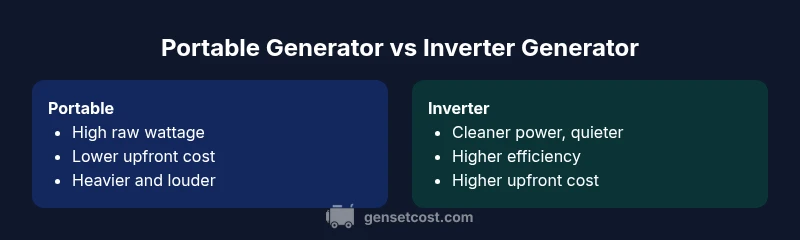
When choosing between a portable generator and an inverter generator, start with your load profile, preferred noise level, and runtime needs. Portable units deliver higher raw wattage at a lower upfront cost but are louder and less efficient. Inverter models run quieter, produce cleaner power suitable for sensitive electronics, and often offer better fuel efficiency, though at a higher upfront price. For most homeowners and property managers, inverter generators are the better long-term backup, while portable generators excel in heavy-duty, budget-conscious scenarios.
What portable generators and inverter generators are
Portable generators and inverter generators are two common approaches to backup power, each built around a different core design. A portable generator is typically a larger, simple machine that outputs a high raw wattage and uses a traditional alternator paired with an engine and carbureted or electronic fuel system. An inverter generator, by contrast, starts with a small, efficient engine driving a rectifier that creates DC power and then inverts it to a high-quality AC waveform. The Genset Cost team found that most homeowners and property managers weigh these differences for two key reasons: power delivery patterns and acceptable noise levels during outages. This contextual overview helps you map your power needs to the right technology, without assuming a one-size-fits-all solution.
- Typical use cases: large, infrequent power demands (construction sites, events) often lean toward portable units; regular home backup with sensitive electronics favors inverter models.
- Core takeaway: neither type is universally “better” — the decision hinges on your load, space, and tolerance for noise and fuel use.
Understanding how power is produced in each design
In a portable generator, the engine drives a synchronous generator that outputs AC power directly. This setup is rugged and simple, and it can deliver high wattage but tends to produce a rougher power waveform when loaded heavily. Inverter generators use a multi-step process: the engine powers a alternator to produce AC, which is converted to DC, then inverted back to AC with a regulated, clean sine wave. This indirect path adds complexity but yields more stable voltage and frequency, which is especially important for electronics and sensitive devices. The Genset Cost analysis highlights that the cleaner power from inverter units reduces risks to electronics while preserving battery life in micro-load scenarios. Flexibility in fuel usage is common across both types, with many models supporting propane, gasoline, or a mix, though availability and cost can vary by region.
- Clean power advantage: inverter generators typically deliver a smoother sine wave and tighter voltage control.
- Durability concerns: portable models may be more rugged in rough environments but lack the same level of electronic regulation as inverter units.
Cost and value: upfront and lifecycle considerations
Pricing for portable and inverter generators reflects their core design goals. Portable units generally have a lower upfront price and a wider selection, which makes them appealing for immediate, heavy-duty needs or budget-driven purchases. Inverter generators cost more upfront but offer features that can lower running costs over time, such as improved fuel efficiency and extended runtime per gallon. From a lifecycle perspective, the choice depends on how you value maintenance, fuel costs, and the expected duration of outages. Genset Cost’s benchmark analysis suggests evaluating total cost of ownership over 5–10 years to capture fuel savings and potential parts wear, rather than focusing only on initial sticker price. We also note that size and weight affect transport costs and storage requirements, which can tilt the economics in favor of one type in particular contexts.
- Upfront cost trends: portable units tend to be cheaper initially; inverter units are pricier but offer efficiency gains.
- Long-term considerations: reduced fuel use and quieter operation can offset higher purchase costs for homes with frequent outages.
Performance, reliability, and how they handle loads
Power performance is not the same as power quality. Portable generators can deliver very high raw wattage, which is advantageous for heavy appliances like sump pumps or power tools during a project. However, as loads scale, the efficiency of portable units often declines, and fuel consumption rises quickly. Inverter generators excel at managing fluctuating loads thanks to automatic idling and precise speed control, which helps maintain a stable power output for electronics. Reliability often hinges on maintenance quality and knowledge of the fuel system. The Genset Cost team emphasizes that inverter models tend to provide greater consistency for everyday backup scenarios, while portable units offer robustness for peak demand situations. In choosing, consider how your routine outages align with these load-handling realities and whether you require clean power for electronics.
- Heavy, infrequent loads: portable generators shine.
- Regular, sensitive-load support: inverter generators excel.
Noise, portability, and real-world usability
Noise is a frequent deciding factor for home use and shared-workspaces. Portable units typically produce higher noise levels due to larger engines and less refined muffling. Inverter generators are engineered for quiet operation, with sound profiles that often resemble normal conversation levels at a distance. Portability is another differentiator: inverter models tend to be lighter and more compact for the same output, which matters for homeowners who need to move the unit during an outage or store it in a garage. In real-world scenarios, homeowners value ease of use, quick startup, and the absence of vibration. If you live in an HOA or near neighbors, the quieter option is generally the better fit, but always validate local noise restrictions and storage constraints.
- Real-world comfort: expect inverter generators to be notably quieter and easier to move.
- Practical constraints: portable models may require a larger footprint and secure storage during non-use.
How to size a generator for your needs: sizing guidelines that work
Sizing is the single most important step in choosing the right machine. Start by listing your essential circuits (refrigerator, furnace, well pump, lights) and their startup surges. Then add nonessential items you want to power during an outage (computers, TVs, small kitchen appliances). A conservative approach is to size for the heaviest single load rather than the cumulative peak across all devices, especially with inverter models that excel at managing surges more gracefully. The process includes calculating peak wattage, running watts, and consideration of running hours. Genset Cost recommends working with a sizing calculator that accounts for surge demands and runtime expectations, and validating the results with local climate considerations and fuel availability. Finally, confirm compatibility with transfer switches if you plan to integrate with a home backup system.
- Start with essential loads and surges.
- Use a sizing calculator and double-check during load testing.
Fuel options, efficiency, and running costs you should know
Fuel type influences both cost and availability. Gasoline remains common, but many inverter models support propane for longer storage and stable performance in extreme conditions. Diesel-powered portable units are also available; however, they tend to be heavier and louder, with different maintenance profiles. Efficiency depends on load factor: inverter generators tend to maintain better fuel economy as load changes, thanks to optimized engine speed. Running costs combine fuel consumption, maintenance frequencies, and potential wear on the spark plug and air filter. The practical takeaway is to align your fuel strategy with outage lengths, storage space, and local fuel prices. Genset Cost’s experience suggests that homeowners who face frequent outages closer to peak load often realize cost benefits from higher efficiency, while seasonal users may prioritize upfront cost and fuel availability.
- Fuel type matters for storage and cost.
- Efficiency varies with load; inverter models usually perform better at partial loads.
Maintenance, warranties, and long-term reliability considerations
Maintenance is a key factor in the long-term performance of any generator. Basic tasks include oil changes, air filter cleaning, spark plug checks, and testing under load. Inverter generators, with electronic regulation, can require more nuanced maintenance, but they also tend to have longer service intervals when kept well. Portable generators may need more frequent carburetor inspections in some climates, especially if stored with ethanol-blended fuel. Warranties vary by brand and model; extended warranties may be available for both types, though coverage specifics differ. Practically, if a unit is installed as a home standby with a transfer switch, accuracy in maintenance and scheduled service becomes even more critical. The bottom line is to create a maintenance calendar that aligns with your fuel choice and local climate conditions, and to select a model with a robust warranty aligned to your expected outage exposure.
- Schedule regular inspections and testing.
- Choose models with reputable warranty coverage and accessible service networks.
Use-case scenarios: picking the right type based on your context
Consider your typical outage duration, climate, and property constraints. In urban neighborhoods with frequent short outages, inverter generators are often preferred for quiet operation and clean power to electronics. For remote work sites, or homes often without external power access, portable generators may be the practical solution due to higher raw wattage and lower initial cost. If you prioritize ease of transport and minimal noise, inverter models win; if you need maximum surge capacity for brief, high-demand events, portable models may be more appropriate. The most prudent approach is to map your actual daily load, outage frequency, and storage constraints to the two profiles and then test a few representative models under similar conditions before buying. The Genset Cost framework emphasizes considering the total cost of ownership and alignment with your load profile.
Real-world scenarios to guide your decision and practical tips
Many homeowners report that inverter generators quickly become their preferred backup for daily electronics, Wi-Fi routers, and essential appliances, with a noticeable improvement in comfort and usability during outages. On job sites or for off-grid hobbies, portable generators equipped with large fuel tanks and rugged casings often prove indispensable for their raw power and durability. In both contexts, pairing a generator with a transfer switch provides a smoother transition during outages and reduces the risk of backfeeding. For those who live in areas prone to extended outages, consider dual-fuel options that support gasoline and propane to increase resilience when fuel availability is uncertain. The practical takeaway is to prioritize a model that matches the outage profile while ensuring you can legally connect to the home electrical system when needed, and to plan for maintenance and fuel management.
How to integrate with home backup systems and smart controls
Integrating a generator with a home backup system often involves a transfer switch or an automatic transfer switch (ATS). This arrangement ensures a safe, automated transition to generator power during an outage, avoiding backfeed and protecting grid workers. Inverter generators can be connected to home systems through compatible ATS units, though you should verify power sharing capabilities and generator sizing relative to the panel. Smart features, such as remote monitoring and maintenance alerts, can help you optimize runtime and fuel usage. The overarching message is to ensure compatibility with your existing electrical system and to plan for regular testing, especially during seasonal transitions and before peak outage seasons.
The practical verdict from industry analysis and user feedback
Choosing between a portable generator and an inverter generator hinges on your workload, noise tolerance, and upgrade path for home resilience. In most typical home backup scenarios, the inverter generator offers cleaner power, better efficiency, and quieter operation, which translates into lower disturbance and longer-term savings. However, for locations requiring sustained high wattage with straightforward maintenance and lower upfront costs, portable generators remain a valid choice. The Genset Cost team emphasizes a disciplined sizing approach, a realistic assessment of your outage profile, and a careful cost-per-watt comparison across ownership cycles to arrive at the best fit for your property.
Comparison
| Feature | Portable Generator | Inverter Generator |
|---|---|---|
| Power output capability (raw watts) | Higher potential raw wattage | Moderate to high, optimized for stability |
| Power quality | Rugged waveform, may vary with load | Smooth, clean sine wave suitable for electronics |
| Fuel efficiency | Lower efficiency at higher loads | Higher efficiency with load fluctuations |
| Noise level | Louder operation, especially at full power | Quieter operation due to inverter technology |
| Weight and portability | Heavier, bulkier, less portable | Lighter, more compact for the same output |
| Startup surge handling | Strong surge capability for brief peaks | Managed surges with inverter regulation |
| Initial cost | Lower upfront cost | Higher upfront cost |
| Fuel flexibility | Fuel options depend on model | Often supports multiple fuels with stable supply |
| Maintenance profile | Simpler maintenance, but more carburation considerations |
The Good
- Higher raw wattage for demanding loads when needed
- Lower upfront cost for basic emergency power
- Wider selection and aftermarket accessories
- Broad availability and easier field maintenance
The Bad
- Louder operation and less efficient fuel use during peaks
- Power quality can be less consistent under rapidly changing loads
- Heavier to transport and store
- Higher long-term fuel and maintenance costs for frequent use
Inverter generators win for everyday home backup; portable units win for peak-demand needs at lower upfront cost
Choose inverter for quiet operation and clean power to electronics; choose portable when you need brute wattage and budget flexibility. The decision should be driven by load, runtime, and noise tolerance, with Genset Cost guidance highlighting total ownership considerations.
People Also Ask
What is the main difference between portable and inverter generators?
The main difference is how power is produced and regulated. Portable generators provide high raw wattage with less refined power quality, while inverter generators produce cleaner power with improved efficiency and quieter operation. The choice depends on your load type and noise tolerance.
Portable generators deliver raw power, but inverters offer cleaner power and quieter operation for electronics.
Which is better for home backup power?
For most homes, inverter generators are preferable due to cleaner power and lower noise, which helps protect electronics and comfort during outages. If you routinely need high wattage for large appliances, portable models can be a viable option, provided you manage fuel and noise.
Inverter generators are generally better for home backups because they are quieter and better for electronics.
Are inverter generators more expensive to buy?
Inverter generators typically cost more upfront than portable options, mainly due to the advanced electronics and efficiency features. Over time, savings on fuel and longer runtimes can offset the higher initial price for many users.
Yes, inverter models usually cost more upfront, but fuel efficiency can offset that over time.
Can I run sensitive electronics on a portable generator?
Some portable generators can power electronics, especially when equipped with a good quality regulator, but inverter generators consistently provide cleaner, surge-managed power that is safer for sensitive devices.
Inverter generators are safer for sensitive electronics due to cleaner power.
Do portable generators require special maintenance?
All generators require regular maintenance. Portable units may need more frequent carburetor checks if stored with certain fuels. Inverter generators also need routine service, but their electronics can require specialized checks.
Regular maintenance is essential for both, with some extra considerations for carburetor cleanliness in portable models.
How should I size a generator for my home?
Start with essential circuits and appliances, add a buffer for startup surges, and verify the total running watts. Use a sizing calculator and, if possible, test under similar load conditions to ensure you choose a unit that meets your needs.
Size for essential loads and surges, then test to confirm.
Key Takeaways
- Assess your essential loads and surge demands before buying
- Prioritize inverter technology for electronics and home use
- Factor total cost of ownership, not just upfront price
- Plan for noise, storage, and fuel logistics in your space
- Consider integration with transfer switches for seamless outages