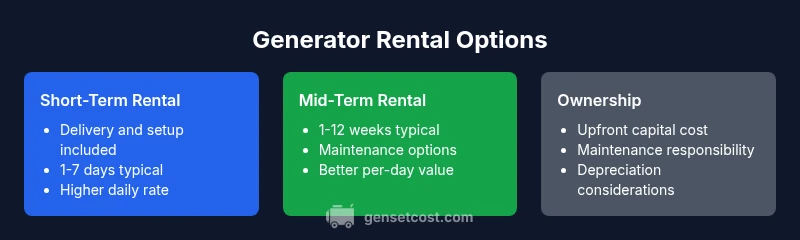
Generator Rental: Side-by-Side Comparison of Options
Compare generator rental options for home backup power, including short-term and mid-term rentals, with insights on costs, delivery, maintenance, and suitability.


Generator rental offers flexible, on-demand power solutions for homes and small businesses. This comparison covers short-term and mid-term rental options versus ownership, highlighting cost, delivery, maintenance, and suitability for outages and events. By weighing duration, capacity, and support, you can choose the most cost-effective approach for your backup power needs.
Overview of Generator Rental
Generator rental has emerged as a practical alternative to purchasing a standby generator, especially for homeowners facing irregular outage patterns or seasonal demand. By renting, you gain access to power when you need it without tying up capital or committing to long-term maintenance. This section outlines the core concepts, including typical rental terms, unit types, and the key differences from ownership. Throughout this guide, we use the term generator rental to refer to all on-demand power solutions that rely on a rental agreement rather than outright purchase. The choice is often driven by expected outage duration, property size, and local regulations, as well as the ability to coordinate delivery, setup, and fuel management with a single provider. The Genset Cost team notes that rental models can be a cost-effective way to test outages and power strategies before committing to more permanent hardware.
When Generator Rental Makes Sense
For many homeowners, generator rental is a pragmatic bridge between temporary power interruptions and permanent investment. Short-term rentals are ideal for hurricane seasons or event-based power needs, while mid-term arrangements suit multi-week outage forecasts or temporary construction sites. Beyond outages, rentals provide a predictable cost structure that helps with budgeting and cash-flow planning. If you are evaluating backup power strategies, generator rental can be used to validate load requirements, fuel logistics, and electrical integration before purchasing a dedicated unit. The flexibility also supports seasonal properties and rental portfolios where power reliability is a critical factor. Genset Cost analysis shows rental programs can reduce upfront risk while offering access to modern, compliant equipment.
Types of Rental Arrangements
There are several ways providers structure generator rental, each with distinct pros and trade-offs. Short-term rentals are typically billed daily or weekly and include basic delivery and setup. Mid-term rentals run for a month or more, often with longer-term maintenance options and enhanced support. Seasonal or event-based rentals may align with peak demand periods, offering scalable power without long-term commitments. A related option is ownership, where you purchase a generator and assume full maintenance responsibility. In this guide, we compare these arrangements to help you select the model that aligns with your outage expectations, site constraints, and budget. The choice often hinges on how long you anticipate needing power and how much you value service coverage and reliability.
Cost Considerations and Value
Cost is a central driver when evaluating generator rental versus ownership. Short-term rates tend to be higher on a per-day basis but include logistics like delivery, setup, and fuel management, which can reduce total ownership costs in the near term. Mid-term rentals typically offer a better per-day rate and may include limited maintenance or service contracts, helping you control operating expenses. Ownership requires capital expenditure up front and ongoing maintenance, fuel, and potential depreciation, but it can yield lower long-term per-kilowatt-hour costs if outages are frequent. It’s essential to estimate the total cost of ownership for your site, including permits, storage, and insurance, alongside rental quotes. Genset Cost emphasizes evaluating total cost of power over your expected outage window rather than just the sticker price.
Short-Term vs Mid-Term Rental vs Ownership: A Clear Cast
Deciding between short-term rental, mid-term rental, and ownership hinges on duration, reliability, and cash flow. Short-term rentals shine for emergency outages or single events where immediate power is required. Mid-term rentals balance flexibility with better unit availability and predictable costs, suitable for multi-week outages or temporary sites. Ownership is best when outages are frequent, or power reliability is mission-critical, and you can absorb maintenance and depreciation in your budget. When you compare, examine not just the daily rate but also delivery charges, set-up complexity, fuel type compatibility, and the provider’s service level agreements. The right choice aligns with your expected outage length, the criticality of continuous power, and your comfort with maintenance responsibilities.
Service Levels, Maintenance, and Responsibility
Rental agreements often bundle delivery and setup, but service levels can vary. Some packages include 24/7 emergency support and routine generator servicing, while others require optional add-ons. Clarify who handles refueling, battery checks, oil changes, and load testing, and whether temporary outage readiness guarantees apply. For most homeowners, a rental that includes maintenance reduces stress during an outage. Be sure to review fuel type compatibility, transfer switches, and electrical interconnection requirements, as these factors influence reliability and safety. The Genset Cost team recommends selecting a provider that offers clear SLAs, timely response windows, and transparent terms for equipment replacement in case of malfunction.
Practical Scenarios and Case Studies
Consider a coastal town preparing for hurricane season. A short-term generator rental could cover the peak outage window, with delivery and setup arranged ahead of landfall and fuel management planned for the duration. For a renovation project spanning several weeks, a mid-term rental can supply the needed power without committing to ownership. In a rural property with infrequent outages, ownership may be cost-effective if you anticipate multiple episodes per year and are prepared to manage maintenance. These scenarios illustrate how generator rental can be tailored to outage likelihood, site constraints, and budget, rather than a one-size-fits-all approach.
Planning, Permits, and Compliance
Power equipment on residential property may require local permits, noise compliance checks, and adherence to electrical codes. Rental agreements should clarify who handles permit applications and whether the provider offers guidance on local regulations. In many markets, delivery timing, placement, and load testing must align with utility guidelines to ensure safety. Planning early can prevent last-minute delays and permit denials. The Genset Cost recommendations include confirming site access, securing required clearances, and coordinating with a licensed electrician for final interconnection and transfer-switch installation.
How to Choose Your Generator Rental Partner
Selecting the right rental partner involves evaluating equipment availability, fleet quality, and service levels. Look for modern, compliant units with fuel-efficient engines and remote monitoring where available. Request a written SLAs, including response times, maintenance windows, and equipment replacement policies. Compare delivery lead times, fuel options, and the provider’s track record for safety and reliability. Finally, verify licensing, insurance, and customer references to ensure a smooth rental experience from start to finish.
Feature Comparison
| Feature | portable generator rental (short-term) | standby generator rental (mid-term) | home backup generator ownership |
|---|---|---|---|
| Typical rental duration | 1-7 days | 2-12 weeks | N/A (ownership) |
| Power capacity (kW) | 5-20 kW | 20-100 kW | 20-60 kW |
| Delivery & setup included | Often included | Often included | Not applicable |
| Maintenance & support | Limited; optional add-ons | Included; OEM service contracts | N/A (ownership) |
| Fuel type | Gasoline/diesel mix | Diesel or natural gas | No |
| Cost snapshot | $30-$100/day | $200-$600/week | N/A (ownership) |
| Permits & noise rules | May require permits | Usually covered by rental | Subject to local rules |
| Best for | Events, storms, temporary outages | Long outages, business continuity | Long-term home backup |
The Good
- Low upfront cost and no long-term commitment
- Flexible power sizing for fluctuating needs
- Delivery, setup, and basic support included
- Fast deployment during outages
- No maintenance hassles during rental period
The Bad
- Higher long-term cost compared to ownership for extended use
- Limited customization and uptime guarantees depending on rental provider
- Fuel management and refueling responsibility may be burdensome
- Potential access restrictions or permit requirements in some areas
Rental is best for short-term, flexible power needs; ownership wins when outages are frequent and long-term reliability matters
For temporary outages or events, generator rental provides speed and flexibility with predictable service. If you expect repeated outages and want long-term cost efficiency, ownership may offer better value. Use our side-by-side comparison to choose the model that aligns with your outage expectations.
People Also Ask
What is generator rental best for?
Generator rental is ideal for short-term outages, events, or temporary projects where power is needed quickly without a long-term commitment. It also lets you test load requirements before purchasing a unit. Consider rental when outages are unpredictable or seasonally driven.
Great for short outages or events where you need power now, with no long-term commitment.
How are rental costs structured?
Costs are typically broken down into daily or weekly rates, plus delivery, setup, and fuel management. Longer mid-term rentals often include maintenance add-ons or service contracts. Always compare total cost over your expected outage window.
Rates usually include delivery and setup, with optional maintenance packages.
Do rental generators come with maintenance?
Maintenance may be included or offered as an add-on. Check what the contract covers, including oil changes, fuel system checks, and battery testing. Clear SLAs help ensure reliability during outages.
Maintenance may be included or available as an add-on; verify coverage in the contract.
Can I rent for a long period?
Yes, many providers offer longer-term rentals, sometimes with reduced daily rates and extended service support. If outages are a recurring issue, compare long-term rental with ownership in terms of total cost and maintenance burden.
Longer rentals are common; compare the overall cost to ownership.
What permits or regulations apply to generator rentals?
Local permits and noise rules may apply to rented generators. Your provider should offer guidance, but you’re ultimately responsible for ensuring compliance and safe interconnection with your electrical system.
Check local rules and permits; the rental provider can help with guidance.
Key Takeaways
- Define outage duration to pick rental length
- Include delivery/setup and maintenance in total cost
- Match generator capacity to your actual loads
- Check fuel type compatibility and permits early
- Use a provider with clear SLAs and guaranteed response times