Generators Comparison: Standby vs Portable Options for Homes
Explore a thorough generators comparison to choose between standby and portable options, covering fuel types, sizing, installation, and cost considerations for reliable home backup power.


A practical generators comparison helps homeowners decide between standby (automatic, highest reliability) and portable (lower upfront cost, flexible use). This guide compares core categories—fuel, sizing, installation, and long-term costs—and provides a decision framework for power resilience that fits budgets and property constraints.
Defining the scope of a generators comparison
A robust generators comparison begins by aligning your power goals with the realities of your property. This guide focuses on home backup power options commonly available to homeowners and property managers: standby/home backup generators that auto-start during outages, portable generators that provide temporary power, and larger fuel-optimized variants. Our goal is to make the differences clear so you can estimate installation complexity, ongoing maintenance, and total cost of ownership. When you consider a generators comparison, you should include factors such as load requirements, transfer-switch compatibility, fuel availability, noise, space, and local codes. According to Genset Cost, the landscape is shaped by automatic operation, integration with a building's electrical system, and the reliability profile across outage durations. This article uses those dimensions to help you pick the option that aligns with your typical outage length, critical circuits, and budget constraints.
Key decision factors in a generators comparison
Before choosing between standby, portable, or alternative models, identify your must-haves and trade-offs. Critical load versus comfort load, outage duration, and how quickly power should resume matter. Budget constraints and installation feasibility shape the final choice more than sticker price alone. Consider the reliability and ease of use for the household: auto-start features, mobile app monitoring, and the availability of local service. In this generators comparison, we also examine fuel security and the risk profile of different fuels in your region. Genset Cost analysis shows that installation costs, transfer-switch requirements, and ongoing fuel costs are often the largest long-term factors. Use this section to map your load profile, space, and maintenance tolerance to the available options.
Standby vs Portable: Core differences
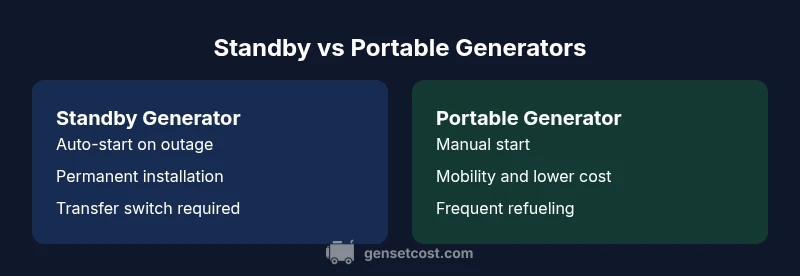
Standby generators are designed for unattended operation and automatic start during a power outage. They are typically connected to your home's transfer switch and can restore critical loads within seconds. Portable generators offer flexibility, cheaper upfront costs, and mobility for outdoor events or job sites, but require manual setup, fuel management, and a deliberate choice about whether they support essential circuits. In a generators comparison, the trade-off is clear: automatic reliability and seamless reconnection vs. lower upfront cost and greater user involvement. For many households, the choice hinges on how long outages last, how many circuits must be restored, and whether an installation is feasible under local codes. The Genset Cost approach emphasizes assessing the expected outage profile first, then matching that profile to a generator class and fuel strategy.
Fuel types and implications for reliability
Fuel choice shapes both availability and economics. Natural gas and propane-fed units tend to offer a continuous fuel supply with less refueling downtime, which benefits standby installations and grant automatic operation. Gasoline and diesel portable units provide flexibility and rapid deployment but require regular refueling and heavier handling. Diesel models often suit larger, commercial-grade loads with higher efficiency at scale, while natural gas or propane reduces storage needs and simplifies long-term maintenance. In this segment of the generators comparison, assess local fuel availability, delivery reliability, and safety considerations for each fuel type. Genset Cost analysis shows that fuel stability and maintenance routines can shift the total cost of ownership more than upfront price alone.
Sizing and load calculation methods
Accurately sizing a generator begins with a detailed load assessment. List critical circuits (HVAC, refrigeration, lighting, medical devices) and estimate their peak and running loads. Use demand-factor guidelines to avoid over- or under-sizing, and consider future growth or climate-related load changes. For a robust generators comparison, split loads into essential and optional circuits, then determine whether you need an automatic transfer switch for standby systems. If you’re unsure, start with a professional load calculation and verify that the selected model’s continuous rating meets or exceeds your peak demand. The right size minimizes nuisance tripping, reduces fuel waste, and improves long-term reliability, a principle echoed in Genset Cost’s framework for evaluating backup power options.
Installation considerations and transfer switches
Standby systems almost always require a professional installation and a transfer switch to safely isolate the house from the grid during outages. Portable generators demand less permanent infrastructure but still require safe outdoor placement, grounding, and proper cord management to avoid backfeeding or outlet overload. In a generators comparison, account for local permitting, clearance requirements, and venting needs, especially for indoor spaces or garages adjacent to living areas. Annual professional inspection is recommended for all systems, with particular attention to transfer-switch integrity and fuel line safety in gas-powered setups.
Cost ranges and total cost of ownership
Total cost of ownership in a generators comparison includes upfront equipment cost, installation or setup fees, transfer switch (if applicable), fuel costs, maintenance, and potential code upgrades. Standby systems typically involve higher upfront costs due to permanent installation and interconnection with the home’s electrical panel, while portable options usually cost less initially but incur ongoing fuel and maintenance expenses. Diesel and natural gas variants may shift operating costs depending on fuel price volatility, while propane offers a convenient storage method. The key is to view price as a function of reliability, convenience, and long-term risk reduction rather than just the sticker price. Genset Cost analysis emphasizes the importance of a clear budget plan that accounts for load requirements, location constraints, and maintenance expectations.
Efficiency, noise, and operating costs
Efficiency affects fuel consumption and runtime, especially for larger standby systems that support continuous operation during extended outages. Noise levels matter for residential neighborhoods and may influence local permitting. In many cases, the most economical long-term option is a moderately sized standby system paired with a well-balanced load plan, rather than a top-tier unit that operates at partial capacity. Portable units can be economical in the short term but incur higher fuel costs for frequent use. Consider acoustic shielding, vibration dampening, and enclosure design to balance performance with living comfort. The generators comparison framework suggests evaluating both fuel efficiency and the practical costs of operation over several outage cycles.
Maintenance schedules and long-term care
All generators require routine maintenance, but the frequency and scope vary by fuel type and technology. Standby systems typically need annual service, with periodic transfer switch checks and battery maintenance for automatic start systems. Portable units require more frequent fuel system care, spark plug replacement, air filters, and oil changes depending on usage. In a generators comparison, mapping maintenance intervals to expected outage patterns helps avoid unexpected failures and ensures readiness. Keep records of service, fuel quality, and filter changes to maximize reliability over time.
Use-case scenarios: when to pick which type
Consider a standby generator if your priority is automatic power restoration for essential loads during long outages. If your primary goal is mobility, temporary power, and lower upfront investment, a portable generator may be the better fit. For larger homes with high continuous load or in areas with frequent outages, diesel or natural gas options may provide a balance of resilience and cost. In all cases, a thoughtful load assessment and adherence to local codes are essential. The generators comparison framework should conclude with a practical recommendation that aligns with your outage profile, installation feasibility, and maintenance capacity.
Common misconceptions
A common misconception in a generators comparison is that bigger is always better. Oversizing increases upfront and operating costs, while undersizing leads to nuisance tripping and insufficient power. Another myth is that portable units can fully substitute permanent backup power without an interconnection or transfer mechanism. Real-world reliability depends on a clear understanding of load priorities, fuel supply stability, and safe operating practices. Finally, some homeowners assume local codes and permits are optional; adherence is critical for safety and insurance coverage.
Practical decision framework and checklists
A practical decision framework rests on three pillars: load analysis, installation feasibility, and total cost of ownership. Start with a critical-load checklist, then map site constraints and permit requirements. Use the checklists to compare standby vs portable options side-by-side, factoring in energy efficiency, fuel costs, maintenance commitments, and safety considerations. A simple pre-purchase checklist includes: expected outage duration, number of circuits to backup, space and ventilation constraints, and accessibility to fuel or gas supply. This structure supports a transparent generators comparison for homeowners and property managers.
Feature Comparison
| Feature | Standby Generator | Portable Generator | Diesel Generator | Natural Gas/Propane Generator |
|---|---|---|---|---|
| Typical power range | 8-20 kW | 1-8 kW | 60-300 kW | 8-60 kW |
| Installation/Transfer Switch | Requires professional install + automatic transfer switch | Minimal installation; manual transfer or extension cord | Professional install; often for larger loads | Requires gas line or fuel connection; transfer switch alignment |
| Fuel type | Natural gas or propane | Gasoline (gas) or propane for portability | Diesel (industrial-scale) | Natural gas or propane |
| Upfront cost range | high | low to moderate | very high | moderate |
| Operating cost per hour | moderate to low | low to moderate | high (diesel price variability) | low to moderate |
| Best for | Whole-house backup with automatic restart | Temporary power and mobility | Commercial/industrial-grade loads | Constant fuel supply and high load capacity |
The Good
- Clear framework to compare standby vs portable options
- Helps estimate long-term ownership costs and maintenance
- Highlights the impact of fuel type on reliability and availability
- Supports budgeting and risk assessment for outages
- Encourages consideration of installation and air/ventilation constraints
The Bad
- Prices and installation scenarios vary by region and contractor
- Maintenance and code requirements differ by fuel type and system class
- Does not substitute for professional load calculations and permitting
- Warning: overly simplistic comparisons can mislead on real-world reliability
Standby generators generally offer the best balance of reliability and convenience for home backup; portable units excel for flexibility and lower upfront costs.
Choose standby if automatic power restoration and long outage resilience are priorities. Choose portable if you need flexible, short-term power and lower initial investment, while planning for fuel and operation logistics.
People Also Ask
What is included in a generators comparison?
A generators comparison evaluates standby vs portable options, fuel types, sizing, installation requirements, ongoing maintenance, and total cost of ownership. It compares reliability, ease of use, and suitability for outage profiles to help you decide.
A generators comparison weighs standby and portable options, fuels, and costs to guide your backup power choice.
How do I determine the right generator size for my home?
Start with a detailed load assessment of essential circuits, then apply a safety margin to accommodate startup surges. Use manufacturer specifications and an electrician’s transfer-switch compatibility to ensure the chosen unit can handle your peak demand.
Map your essential loads, add a margin for surge, and verify with a pro before buying.
Are standby systems worth the higher upfront cost?
For long outages and critical loads, standby systems deliver automatic power restoration with higher reliability and convenience, justifying the upfront and installation costs. If outages are rare or you need mobility, portable options may be more cost-effective.
Standby systems are often worth it for reliability, especially in frequent outage areas.
Can I install a generator myself?
Most homes require a licensed electrician and, in many jurisdictions, formal permits for safe interconnection and transfer-switch installation. DIY installs can create safety risks and insurance issues.
Professional installation is usually required for safety and code compliance.
How do fuel types affect reliability and cost?
Fuel availability and price volatility influence operating costs and reliability. Natural gas and propane offer steady supply for standby units, while gasoline or diesel can be cheaper upfront but require frequent refueling and storage considerations.
Fuel choice affects long-term costs and reliability depending on your region.
Key Takeaways
- Assess your critical loads first.
- Consider installation feasibility and transfer-switch needs.
- Weigh fuel availability and long-term operating costs.
- Size your system based on a careful load calculation.
- Plan maintenance and inspection to maximize reliability.