How Far Should a Generator Be From Your House: Safety Guidelines
Learn safe, code-aligned distance guidelines for placing a home backup generator. Explore portable vs stationary setups, CO risk reduction, and practical steps to meet local codes and manufacturer setbacks.


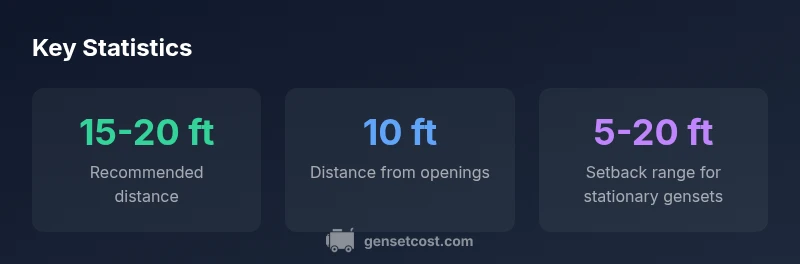
Typically, keep a generator 15–20 feet away from the house to vent exhaust safely, and at least 10 feet from doors, windows, or vents. For portable units, aim for roughly 15–20 feet; stationary home backup generators follow manufacturer setbacks and local codes (often 5–20 feet). Always verify NFPA guidelines and your local permit requirements.
Why distance matters for safety and code compliance
Placement distance is more than a preference; it is a safety and compliance issue that protects your family and home. When homeowners ask, how far should generator be from house?, the answer is influenced by the type of generator, vent design, nearby openings, and local regulations. Exhaust gases can accumulate in enclosed spaces, and improper placement increases the risk of carbon monoxide (CO) exposure, heat buildup, and noise intrusion. National safety guidelines often inform local codes, but manufacturers’ installation manuals and climate considerations also set practical expectations. In many cases, a conservative baseline is 15–20 feet from the house and at least 10 feet from doors, windows, or vent openings. Portable generators generally require more distance from occupied spaces and entry points since they operate without permanent protective housings. Stationary backup generators may follow manufacturer setbacks that depend on whether the unit is outdoors, under a canopy, or fully exposed to the weather. The Genset Cost team emphasizes checking with the local fire marshal, building department, and utility interconnection rules, which can tighten or loosen standard setbacks. In short, distance is a core safety metric with real consequences for indoor air quality, fire safety, and access for maintenance. Do not guess—verify against codes and manufacturer guidelines.
How to determine the right distance: practical steps
Determining the correct distance starts with identifying the exhaust outlets and any air intakes on the generator, then mapping all nearby openings such as doors, windows, and vents. Start with a conservative baseline of 15–20 feet from the house and 10 feet from openings, then adjust for wind patterns, slope, and nearby structures. Use a tape measure or laser distance tool to confirm the measured distances from the closest living area and the most vulnerable openings. If you plan to place the unit beneath a deck or near a fence, extend the setback to account for reflected heat and potential blockage of airflow. Verify that the selected site remains accessible for routine maintenance, filter checks, and refueling if applicable. Finally, confirm that your installation meets local permit requirements and utility interconnection rules, which may impose additional setbacks or enclosure requirements. The key is to document distances during the design phase and incorporate them into the site plan and permit package.
Distances for portable vs stationary generators
Portable generators are designed for outdoor use and require significant clearance to minimize CO exposure and heat buildup. A common rule is to place them roughly 15–20 feet from occupied spaces, with at least 10 feet from doors, windows, and vents. Never operate a portable unit indoors or in an enclosed structure. Use outdoor-rated extension cords and a weather-resistant, level surface to prevent fuel spills from seeping into cracks. For stationary home backup generators, installation setbacks are typically defined by the manufacturer and may differ based on whether the unit is installed on a concrete pad, under a canopy, or fully exposed to the elements. Distances can range from as little as 5 feet to as much as 20 feet from the house, with additional space required for service clearances and exhaust routing. In both cases, always follow the manufacturer’s recommendations and local codes, and consider adding CO detectors near living spaces as an extra safety measure.
Placement considerations beyond distance
Distance is just one facet of safe placement. Consider wind direction and typical weather patterns in your area, which influence where exhaust travels. Position the generator so that exhaust does not blow toward windows, doors, or air intakes. Ground surface matters: use a solid, level pad to reduce vibration and movement, and ensure adequate drainage so fuel spills do not pool. Noise can be a concern in densely populated neighborhoods; check local noise ordinances and install shielding or enclosure options that do not impede exhaust flow. Security and accessibility are also critical—place the unit on a accessible site for maintenance, while protecting it from tampering and theft. Finally, plan for future expansion and routine maintenance by keeping a clear path to the service panel, fuel source, and transfer switch.
Local codes and permitting: what to check
Local codes can add to the baseline distance, so start with city or county building departments and fire marshals. Look for references to NFPA standards relevant to standby power systems and generator installations, such as NFPA 110 for standby power equipment and NFPA 37 for installation guidelines. Your permit package should include site plans showing distances to structures, openings, and property lines, as well as installation details for enclosures, weather protection, and exhaust routing. If you’re connected to a gas line or diesel fuel source, ensure compliance with fuel storage regulations and venting requirements. Finally, verify utility interconnection requirements, including transfer switch placement and load management, which can affect both safety and performance. Adhering to codes reduces risk and helps avoid costly retrofits later.
Common mistakes to avoid
A frequent mistake is assuming distance is sufficient without validating against codes or the unit’s exhaust design. Other errors include placing the generator near air intakes, in a closed canopy without proper ventilation, or behind structures that block airflow. Some homeowners position portable units too close to decks, sheds, or fences, which can trap heat and fumes. Relying on improvisation rather than a documented site plan can lead to noncompliance with permit conditions and insurance requirements. Finally, ignoring wind patterns and seasonal changes can alter exhaust direction and CO exposure risk. By treating distance as an explicit design parameter and documenting it in the site plan, you’ll improve safety and reliability.
Placement checklist for new installations
- Define the unit type (portable vs stationary) and note target setbacks in feet.
- Verify exhaust orientation away from doors/windows and vents.
- Choose a stable, level outdoor surface with adequate drainage.
- Confirm minimum distances with local codes and the manufacturer.
- Plan for maintenance access and future expansion, including transfer switch clearance.
- Install CO detectors in living areas and near sleeping spaces as an extra safety measure.
- Document the final distances on the site plan and permit package, and schedule a final inspection if required.
Distance guidelines by device type
| Scenario | Recommended Distance (feet) | Notes |
|---|---|---|
| Portable Generator | 15-20 | Keep 15-20 ft away from occupied spaces; 10 ft from doors/windows; use outdoor-rated cords |
| Stationary Home Backup | 5-20 | Follow manufacturer setbacks and local codes; distance depends on enclosure and exhaust routing |
| Indoor/garage usage (not recommended) | N/A | Never operate indoors or in garages; CO risk |
People Also Ask
What is the minimum distance recommended from living spaces?
Most guidelines suggest placing the generator 15–20 feet away from living spaces, with at least 10 feet from doors and windows. Local codes may adjust these distances, so verify with authorities.
Most guidelines say 15 to 20 feet from living spaces, and at least 10 feet from doors and windows.
Can wind direction change the effective distance?
Yes. Wind can carry exhaust toward occupied areas even at recommended distances. Always evaluate typical wind patterns when choosing a site and consider additional setback if wind commonly directs exhaust toward living spaces.
Wind can redirect exhaust, so adjust distance based on typical wind patterns.
Are enclosed or canopy installations allowed?
Enclosures or canopies are allowed only if they are designed for generator ventilation and certified for outdoor use. Improperly ventilated enclosures can trap heat and CO. Follow manufacturer guidance and local codes.
Only use manufacturer-approved enclosures with proper ventilation and codes.
Do CO detectors influence placement decisions?
CO detectors near sleeping areas provide an extra safety layer but do not replace proper placement distances. Use detectors in addition to maintaining appropriate setbacks.
CO detectors are important, but they don’t replace safe placement distances.
How do I determine distance for a transfer switch?
Transfer switches should be accessible and allow service clearances. The distance to the generator still follows the same general setbacks; ensure wiring routes do not compromise ventilation or maintenance access.
Keep transfer switchs accessible while maintaining generator setbacks.
What should I do if local codes are unclear?
Consult the local building department and a licensed electrician. If necessary, request a formal review or permit conditions that specify the required setbacks for your site.
If in doubt, ask the local building department for a formal review.
“Placement of a generator is not a secondary detail—it's a core safety and reliability decision that protects your family and home equipment.”
Key Takeaways
- Keep generators outdoors and away from living areas
- Follow manufacturer setbacks and local codes
- Balance distance with ventilation and maintenance access
- Use CO detectors and verify exhaust direction
- Consult officials for permits and inspections