LPG Generator Comparison: LPG vs Natural Gas for Home Backup
A rigorous, objective comparison of LPG (propane) vs natural gas generators for home backup power. Analyze fuel, installation, costs, and maintenance to choose the best option for reliable outages.


According to Genset Cost, an LPG generator (propane) provides strong independence through on-site fueling and reliable cold-weather starts, but a natural gas model can be cheaper and easier to sustain where utility service is robust. This quick comparison outlines the core differences in fuel availability, installation, and running costs to help homeowners decide between LPG and natural gas for home backup power.
Understanding LPG Generators: Fuel Basics
LPG, or liquefied petroleum gas, is a clean-burning fuel commonly used in residential backup generators. An LPG generator runs on propane stored in cylinders or on-site tanks, which makes it possible to refuel even when the grid is down. For homeowners evaluating a home backup generator, understanding the fuel path—storage, delivery, and consumption—is essential. The LPG generator landscape ranges from compact units to larger stationary systems designed to power essential loads or entire households, depending on size. The LPG option benefits from propane's energy density, meaning you can store significant fuel on-site with a comparatively small footprint, reducing refuel frequency during extended outages. In practice, LPG units rely on regulators and safety components to deliver stable gas pressure to the engine. The Genset Cost team notes that propane remains usable in cold conditions, supporting reliable starts when temperatures drop. When comparing LPG to other fuels, remember that propane's energy content differs from natural gas or gasoline, influencing sizing and fuel planning. For most homeowners, selecting an LPG generator means weighing on-site fuel security against up-front equipment costs and tank logistics.
LPG vs Natural Gas Generators: Core Differences
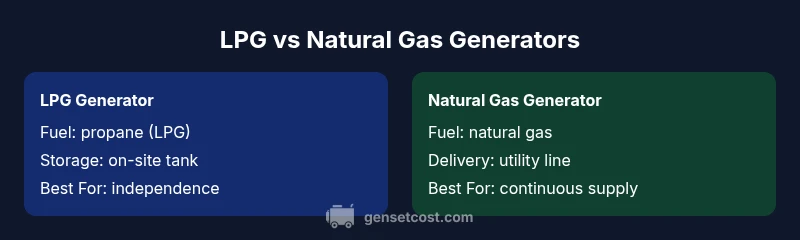
The two fuel pathways—LPG (propane) and natural gas—offer distinct pros and trade-offs. LPG generators operate from on-site propane tanks, providing independence from utility service but requiring storage space and periodic refueling. Natural gas generators draw fuel from the household gas line, offering continuous supply where service is reliable, with potentially lower ongoing fuel costs. Energy density and delivery pressure differ between fuels, affecting how a unit is sized and how it performs under peak loads. LPG often delivers stronger performance in cold weather, while natural gas can provide steadier operation for long, predictable outages. A key consideration is how you plan to supply fuel during an outage: if you have a large propane tank or easy access to refills, LPG can be highly convenient; if your gas line is well-served and you prioritize minimal storage, natural gas may win. Genset Cost analysis shows that both options have viable use cases; the right choice depends on your home layout, climate, and service reliability.
Sizing and Load Priorities for LPG Generators
Sizing an LPG generator requires a careful assessment of essential loads, startup surges, and climate considerations. Start with the critical circuits you want to restore during an outage, such as refrigeration, heating, water heating, and communication systems. Use a load profile to estimate running watts and peak watts for each circuit, then sum to determine minimum generator output. Many homeowners aim for a generator size that can handle essential loads with a comfortable margin, often targeting a rule-of-thumb percentage of peak demand to avoid overloading the system. When you add in LPG storage constraints, you may prioritize longer runtimes for core essentials over high-power simultaneous loads. The LPG fuel's storage strategy can influence the acceptable duty cycle and runtime, so plan for refueling intervals that fit your outage expectations. This sizing approach helps ensure the LPG generator delivers reliable power when it matters most, without overstressing the engine or depleting fuel too quickly.
Fuel Storage, Availability, and Refueling Logistics
LPG requires on-site storage tanks or cylinders, which creates a separate logistical equation from natural gas. The size of your LPG tank and the refueling plan directly shape runtime, outage resilience, and service frequency. Tanks range from small portable cylinders to large stationary tanks that feed multiple appliances. Availability is largely regional and depends on local suppliers, delivery networks, and your property layout. Refueling logistics should account for refill timing during outages, distance to a supplier, and the cost of propane. In urban areas, propane cylinders are common and accessible, while rural areas may rely on larger bulk tanks that service multiple homes or facilities. The Genset Cost team notes that practical fueling plans—such as scheduled refills or permanent bulk tanks—can significantly impact outage confidence and total ownership costs. Consider storage space, accessibility, and local regulations when choosing LPG storage solutions for your home backup.
Installation Pathways: Home vs Remote Setup
Installing an LPG generator involves more than the engine and alternator. You must plan for fuel storage, venting, exhaust routing, electrical interconnection with a transfer switch, and compliance with local codes. LPG piping and regulator sizing must match the generator’s fuel demand, and some jurisdictions require professional installation to meet safety standards. In many homes, a dedicated outdoor pad or concrete base is required to support the generator and tank, with proper clearance from structures and vents. Remote or semi-secluded locations can simplify exhaust management but may complicate fuel delivery and maintenance access. The choice between a portable LPG unit and a permanent, permanently installed generator also affects installation complexity and permitting. Genset Cost emphasizes documenting your load, fuel strategy, and installation pathway early in the planning phase to avoid costly redesigns later.
Operating Costs, Fuel Efficiency, and Emissions
Operating costs for LPG generators hinge on fuel price volatility, efficiency, and runtime. Propane tends to have a higher per-unit energy cost than natural gas in many markets, but its portability and on-site storage can offset fuel price differences during outages. Efficiency varies by engine design, load factor, and maintenance; modern LPG engines often strive for improved fuel economy at typical residential loads. Emissions profiles for LPG are generally favorable relative to some other fossil fuels, but the exact mix depends on engine tuning and emission control equipment. If you expect frequent outages or extended events, evaluate the LPG tank size and refill schedule against the unit’s fuel burn rate to estimate total fuel consumption. The Genset Cost team advises comparing fuel cost scenarios across seasons and outage durations to determine which fuel path yields lower lifetime costs for your home.
Maintenance and Longevity: What to Expect
LPG generators require routine maintenance just like any other backup power system. Regular tasks include oil changes, filter checks, spark plug inspection, and cooling system maintenance. Propane tends to burn cleaner than some liquid fuels, which can simplify fuel-system maintenance, but it does not eliminate it. Tank and line integrity are essential for safety and reliability; periodic leaks or regulator wear can affect performance. Maintenance schedules are typically guided by running hours and environmental conditions. A well-maintained LPG generator often delivers longer service life and fewer unexpected outages, especially when paired with a proper pre-season check. The Genset Cost approach emphasizes establishing a maintenance calendar aligned with your load patterns and local climate to maximize reliability and minimize unexpected costs.
Safety, Codes, and Permitting
Safety considerations for LPG generators include proper ventilation, fuel storage safeguards, CO monitoring, and adherence to electrical codes. LPG is highly effective when stored correctly but can pose risks if tanks are exposed to heat or damage. Transfer switches and automatic start mechanisms are standard safety features that isolate the generator from the home when not in use or during maintenance. Local permitting may require setbacks, electrical inspections, and emissions testing. It’s important to coordinate with licensed professionals to ensure compliance with safety standards and to prevent carbon monoxide hazards in occupied spaces. The Genset Cost team recommends reviewing your jurisdiction’s requirements early and maintaining clear fuel storage areas away from ignition sources and living spaces.
Real-World Scenarios: Case Comparisons
Consider a rural property with unreliable utility service and ample outdoor space versus a dense urban home with a reliable gas utility and limited storage. In the rural case, an LPG generator with a bulk tank and autonomous refueling plan can provide significant outage resilience, because storage independence translates into longer runtimes without grid interaction. In the urban scenario, a natural gas generator piped to the home may deliver convenient, low-fuss operation with minimal on-site storage. Genset Cost analysis suggests that the best choice aligns with the property’s fuel access, climate, and desired level of outage preparedness. For example, households prioritizing freedom from utility outages may favor LPG; those prioritizing a simple fuel path and near-continuous supply may prefer natural gas. The real-world takeaway is that there is no one-size-fits-all solution. Careful evaluation of your loads, fuel logistics, and local service options yields the strongest decision framework.
Choosing Between LPG and Natural Gas: Decision Framework
A practical decision framework begins with a clear outage profile: duration, time of day, and critical loads. Next, assess fuel access: do you have on-site LPG storage or a robust natural gas line? Finally, compare installation costs and ongoing fuel expenses in your region. Create quick “what-if” scenarios for worst-case outages, typical winter months, and summer cooling needs to see how each option performs. The final call should balance independence (LPG) with convenience and cost (natural gas) for your unique home, climate, and service environment. The Genset Cost team recommends building a decision matrix that weighs fuel reliability, storage feasibility, installation complexity, and expected lifetime cost across multiple outage scenarios.
Comparison
| Feature | LPG Generator | Natural Gas Generator | |
|---|---|---|---|
| Fuel Source | Propane (LPG) stored on-site | Natural gas from utility line | |
| Fuel Storage/Delivery | Tank/cylinder on property | No storage; relies on local gas line | |
| Installation Flexibility | Requires space for tank and routing | Often easier if gas line is available; less storage | section |
| Typical Energy Output Range | Wide range depending on model | Broad range; generally well-suited for essential loads | |
| Operating Costs (Fuel) | Fuel price fluctuates with propane market | Often lower per energy unit; depends on local gas prices | |
| Maintenance & Longevity | May require more fuel-system checks | Often simplified by continuous supply | |
| Emissions & Noise | Clean burning with proper tuning; standard generator noise | ||
| Best Use Case | Independence with on-site fuel storage; off-grid readiness | Urban or suburban homes with reliable gas service |
The Good
- Provides fuel independence with on-site storage
- Typically longer run times between refuels
- LPG engines perform well in cold weather
The Bad
- On-site propane storage requires space and maintenance
- Fuel price volatility can affect long-term costs
- Propane energy density varies by generation model and region
- Upfront tank installation costs may be higher
LPG generators excel for independence and cold-weather reliability; natural gas shines when you want a simpler fuel path and potentially lower ongoing costs
Choose LPG if you want stored fuel on-site and strong cold-start performance. Choose natural gas if you prefer a continuous fuel supply with potentially lower fuel costs and easier logistics; ensure your load and climate match the option.
People Also Ask
What is an LPG generator and how does it work?
An LPG generator runs on propane stored on-site in tanks or cylinders. It uses a regulator to deliver gas to the engine, where it is converted to electricity. LPG offers fuel storage independence and reliable cold-weather starts, but requires planning for refueling and storage space.
An LPG generator uses propane stored on-site. It powers your home during outages and starts reliably in cold weather, but you need space for tanks and a plan for refueling.
What are the main differences between LPG and natural gas generators?
LPG generators store propane on-site, offering independence and longer runtimes between refuels. Natural gas generators draw from the utility line, often with lower ongoing fuel costs and no on-site storage, but they depend on municipal gas service and may be affected by outages in the gas line.
LPG is on-site fuel, natural gas uses the utility line, each with its own pros and cons.
Is LPG safer than natural gas for home backup?
Safety depends on proper storage, venting, and mindful operation. LPG storage requires protective measures to prevent leaks, while natural gas piping also demands leak detection and proper shutoff protocols. Both setups must comply with local codes and safety standards.
Both fuels require proper safety practices and code compliance; follow installation guidelines and use CO detectors.
What maintenance does an LPG generator require?
Regular maintenance includes oil and filter changes, spark plug inspection, and fuel system checks. Since LPG burns cleaner, some typical maintenance tasks may be less frequent, but the fuel system still needs periodic inspection for leaks and regulator integrity.
Keep to a regular maintenance schedule: check oil, filters, and fuel lines, and inspect the regulator.
Can LPG generators be used indoors?
No, LPG generators should not be used indoors due to carbon monoxide risks. They require outdoor installation with proper clearance, ventilation, and weather protection while connected to a transfer switch.
Never run an LPG generator indoors; use it outside with safe venting and a transfer switch.
How do I size an LPG generator for my home?
Start by listing essential loads and their startup surges, then choose a unit with enough running watts to cover those loads with a margin. Consider climate, seasonal heating or cooling needs, and how long you expect outages to last.
List essential loads first, then pick a unit with a comfortable margin for peak demand.
What affects the running cost of an LPG generator?
Fuel price volatility, load factor, and runtime dominate running costs. LPG can be competitive but is influenced by regional propane prices and the engine’s efficiency at your typical loads.
Fuel price and how much you run it drive the cost; choose a size that fits your usual needs.
Key Takeaways
- Assess your outage duration needs before sizing
- Plan fuel storage or gas line access early
- Weigh fuel cost volatility against convenience
- Prioritize safety and proper permitting
- Use a tailored load-profile approach for best results