What Generator to Use: Essential Sizing Guide for 2026
A practical, step-by-step guide helping homeowners choose the right generator for home backup, with sizing tips, fuel options, installation considerations, and costs.


To choose what generator to use, start by mapping your essential loads, then compare standby versus portable units by fuel type, transfer switch options, and expected runtime. This quick approach helps homeowners select a safe, cost-effective solution for typical outages.
Understanding the goal: what generator to use
Choosing the right generator begins with a clear goal: keep essential circuits powered during an outage. For many homes, a standby generator with an automatic transfer switch provides seamless operation to major loads the moment the grid goes down. If space is tight or you only need a small portion of circuits, a well-chosen portable unit can cover critical devices for a few hours. This section frames the decision by considering reliability, space, and total cost, and by distinguishing standby from portable options. The core idea is to balance reliability, cost, and space when selecting a generator type.
Estimating your power needs: running vs starting watts
To determine what generator to use, start with a precise load assessment. List every appliance and circuit you want to power during an outage. Record running watts for continuous devices (refrigerators, sump pumps, lights) and starting watts for motor loads (air conditioners, well pumps). If a device does not list watts, use a wattage guide or a sizing calculator and apply a conservative estimate. Sum the running watts of all continuous devices, then add the starting watts for motor loads, and avoid double counting startup surges. Design for roughly 1.25 to 1.5 times the running watts to accommodate spikes. This baseline guides your generator selection.
Fuel options and efficiency
Next, compare fuel types and efficiency, which strongly influence long term costs and practicality. Gasoline units are common and portable but require steady refueling and have limited shelf life. Propane or natural gas offer longer storage and easier refueling, but require adequate supply lines or tanks. Diesel is efficient for larger standby units but can be noisier and costlier upfront. Evaluate efficiency via load factor and runtime at your expected load. If outages could be long, a natural gas line or propane tank may be more reliable; a liquid fuel unit can work for shorter outages or remote locations. The right balance of convenience, reliability, and lifecycle cost is key.
Sizing considerations by property
Your home characteristics determine the right size. Size for essential loads first, then account for climate driven needs such as heating or cooling. Homes with heat pumps or central AC have higher start loads, so plan for higher capacity. The number of stories, insulation quality, and window efficiency influence overall demand. If you already have solar or battery backup, your generator may be a supplementary source rather than the sole solution. Use a load calculator to translate results into a wattage or kilowatt rating and consider future expansions. In short, focus on critical loads, and leave room for growth.
Transfer switches and install considerations
Planning the transfer switch setup is a core step. A transfer switch isolates your home from the grid during an outage, directing power to selected circuits safely. Automatic transfer switches start the generator automatically, offering convenience but with higher upfront cost and more complex wiring. Manual switches are cheaper and simpler but require user action. Confirm panel space and ensure the generator matches the panel amperage. Place the unit outdoors with adequate clearance and a solid surface for maintenance. A licensed electrician can confirm clearances, wiring methods, and code compliance. If you plan a subpanel or backfeed, ensure interlocks or transfer switches prevent backflow into the grid.
Cost considerations and budgeting
Budgeting starts with total ownership costs. Portable generators are cheaper to purchase but require fuel, maintenance, and manual setup during outages. Standby generators have higher upfront costs but offer automatic power, quieter operation, and long term convenience. When sizing to price, include generator cost, transfer switch, installation, permits, and ongoing fuel or gas service. Many homeowners find that the decreased outage downtime and improved home safety justify the investment. Compare warranties and service networks across models, and factor maintenance costs such as oil changes, air filters, battery checks, and periodic exercise runs. Prices vary by capacity and features, so obtain multiple quotes and verify what is included in each package.
Brand and model selection criteria
With the right size in mind, choose a brand and model that balances reliability, warranty, and service availability. Look for a strong parts network and a clear maintenance schedule. Read independent reviews and verify safety testing relevance to your locale. Ensure compatibility with your transfer switch and your existing electrical panel. Consider heat tolerance, noise, and efficiency ratings; quieter models can be a big factor in residential installations. Prioritize units with solid warranties and accessible local service technicians. A well supported generator reduces downtime and provides peace of mind for homeowners and property managers alike.
Safety, permits, and code compliance
Investing in the right generator means prioritizing safety and compliance. Electrical work should be performed by licensed professionals who secure permits and ensure wiring to the main panel is up to code. Interlocks, transfer switches, and backfeed protection must be correctly installed to prevent backflow into the grid. Outdoor placement is essential to avoid CO buildup; keep the unit away from doors and windows and use outdoor-rated cords. Store fuel per local fire codes with proper venting and distance from structures. Regular maintenance reduces failure risk and extends life. Check local codes for setback distances and noise limits, and coordinate with your installer to meet standards such as NFPA 37 and NFPA 70. A safety-first approach protects lives and property and ensures dependable operation when outages occur.
Quick-reference checklists
Before purchasing, verify the essentials: a complete loads list, estimated running and starting watts, fuel availability, transfer switch type, panel compatibility, outdoor placement, permits, and a maintenance plan. This checklist helps you compare quotes and ensure you have covered all critical considerations. Keep notes on warranties and service coverage to avoid surprises later.
Authorities and references
For further guidance, consult authoritative sources: Energy.gov for general backup power guidance, the National Renewable Energy Laboratory (nrel.gov) for energy efficiency and sizing tools, and OSHA safety guidelines for electrical work. These sources provide context on safe operation, installation practices, and long term performance considerations.
Tools & Materials
- Appliance wattage list(Record running watts and starting watts for each device)
- Wattage calculator or sizing tool(Online or spreadsheet to estimate total load)
- Basic electrical tools(Multimeter, insulated screwdriver, voltage tester)
- Safety gear(Gloves, eye protection, and hearing protection)
- Transfer switch options(Manual or automatic, compatible with your panel)
- Gas or propane supply info(Know line size and pressure if using natural gas or propane)
Steps
Estimated time: Total time: 60-120 minutes to gather loads and size, plus installation time with a pro
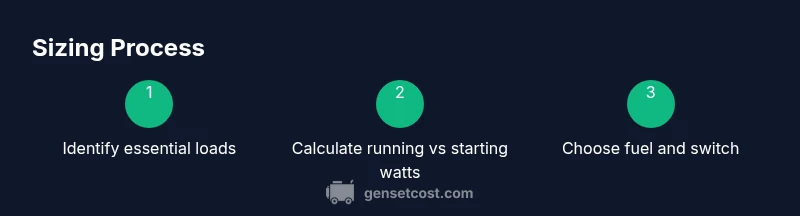
- 1
List essential loads
Identify which circuits and appliances must stay powered during outages. Include refrigerators, freezers, sump pumps, lights, and communications. This establishes the baseline you’ll size your generator against.
Tip: Use a home outage scenario to estimate their combined running watts. - 2
Calculate running watts and starting watts
Sum running watts for continuous devices and include starting watts for motor loads. Don’t double count overlaps. Use a wattage calculator to validate your numbers.
Tip: For motors, plan for the higher starting watts to prevent overload. - 3
Select fuel type and transfer switch
Decide on natural gas, propane, or liquid fuel, and choose between manual or automatic transfer switches compatible with your panel.
Tip: Automatic transfer switches offer convenience but come with higher upfront cost. - 4
Assess outdoor placement and ventilation
Place the generator outdoors on a solid surface with ample clearance. Ensure proper ventilation to avoid carbon monoxide hazards.
Tip: Keep exhaust away from doors and windows; install a CO detector nearby. - 5
Plan installation and permits
Work with a licensed electrician to handle wiring, permits, and compliance with local codes.
Tip: Never attempt full electrical installation without professional help. - 6
Create a maintenance and budget plan
Outline routine maintenance, fuel planning, and a realistic budget including quotes for installation and ongoing costs.
Tip: Schedule annual test runs to verify readiness.
People Also Ask
What is the difference between standby and portable generators?
Standby generators are permanently installed and auto-start during outages; portable units are movable and require manual startup. Choose based on needing convenience and space.
Standby generators are fixed and auto-start; portable units require manual startup.
How do I calculate running watts vs starting watts?
Add running watts for continuous devices and include starting watts for motors. Use a wattage calculator to avoid overestimating capacity.
Add up running watts and include starting watts for motors; use a calculator to be precise.
Do I need a transfer switch?
A transfer switch isolates your home from the grid and directs power to the appropriate circuits. It improves safety and reliability; code often requires it.
Yes, a transfer switch makes it safer to power your home during outages.
What fuel type is best for emergencies?
Natural gas offers steady supply if you have lines; propane is easy to store but requires tanks; diesel suits larger standby units but is less common for homes.
Natural gas is convenient if available; propane is easy to store; diesel works for larger needs.
Is it safe to install a generator myself?
Electrical work for generators should be done by licensed professionals to ensure safety and code compliance.
No, hire a licensed pro to handle wiring and permits.
How much does a home standby generator cost?
Costs vary by capacity and installation; portable units are cheaper to purchase but standby systems offer automatic power.
Costs depend on size and install; portable units cost less than installed standby systems.
What maintenance does a generator require?
Regular oil changes, air filter checks, and battery tests keep a generator ready. Schedule annual exercise runs.
Keep oil changed, filters clean, battery good; run a test yearly.
Watch Video
Key Takeaways
- Size for essential loads first
- Standby is automatic and convenient
- Place outdoors with proper ventilation
- Use licensed pros for installation
- Budget for maintenance and replacement parts