How Does a Generator Connect to a House?
A comprehensive, step-by-step guide to connecting a generator to your home safely, including transfer switches, permits, and maintenance tips for homeowners and property managers.


Learn how to connect a generator to a house safely and legally. This guide covers when you need a transfer switch or interlock, how to size and position equipment, and the critical safety steps to prevent backfeed and shocks. By following these steps, homeowners can plan a compliant installation. We’ll explain portable vs standby options and outline permit considerations.
Safety foundations for generator connections
If you’re wondering how does a generator connect to a house, the first answer is safety. This is not a casual DIY project. According to Genset Cost, most outages reveal serious risks when people skip switching devices, misuse cords, or work near live panels. Start with a clear plan that includes the right equipment, proper clearances, and required permits. Do not operate a generator indoors or in partially enclosed spaces; carbon monoxide buildup is deadly. Ensure you have outdoor-rated fuel storage, safe exhaust placement, and a dedicated disconnect near the setup. Confirm that your electrical service has the capacity for a backup load, and arrange for a licensed electrician to review your plan before any hardware is installed. Clear labeling, a well-lit work area, and a written safety checklist dramatically reduce the chance of shocks, fires, and backfeed. This foundation keeps your home and neighbors safe during outages.
How power flows in a home with a generator
When a generator is connected to a house, the goal is to keep utility power separate from generator power except when you want them to work together during an outage. A transfer switch or interlock arrangement creates a controlled path that isolates the home from the grid when the generator is running. With the switch in the correct position, the main panel feeds essential circuits only, while the grid remains disconnected. This arrangement prevents backfeeding into the utility lines, which can endanger line workers and damage equipment. It also ensures that the generator does not feed through an unprotected outlet or the wrong breaker, which could cause shocks to occupants or start fires. A well-designed connection provides reliable power to critical circuits, such as refrigeration, heating, medical devices, and sump pumps, without compromising overall home safety.
Transfer switches vs interlock kits: what's the difference
Transfer switches come in two broad flavors: automatic (ATS) and manual. An ATS automatically senses a power outage and switches the home to generator power within seconds, keeping critical circuits active without manual intervention. A manual transfer switch requires you to switch the configuration yourself, typically after starting the generator. An interlock kit, installed on a standard panel, creates a safe path between the utility and generator service by physically blocking simultaneous connection. Each option has trade-offs in cost, convenience, and space. For most homeowners, a properly sized ATS with a dedicated transfer path offers the smoothest operation, while interlock kits can be a cost-saving alternative if your panel supports them and the installation is done to code.
Sizing a generator for essential loads
Sizing a generator starts with a house load assessment: identify essential circuits you want to power during an outage and estimate their running and starting demands. Prioritize critical systems first, such as refrigeration, water, heating, and security. Don’t assume all loads will run at once; rather, plan for simultaneous operation of the heaviest appliances in your essential set. Use a professional calculator or consult your electrician to translate this into generator output requirements. Remember that starting wattage for motors often exceeds running wattage, so you must choose a unit with a comfortable margin. A well-sized generator reduces nuisance outages and minimizes fuel use, making the backup more reliable and cost-effective over time.
Choosing between standby and portable options
Standby generators are permanently installed and paired with an automatic transfer switch, offering hands-off operation during outages and a higher level of reliability. Portable units are cheaper upfront but require manual setup, fueling, and transfer-switch use, making them more labor-intensive during an outage. The choice depends on how much power you need, your space, and how you want to manage fuel and maintenance. Homeowners often start with a portable unit for smaller outages and upgrade to a standby system as needs grow. Whatever you select, ensure the solution is installed and tested by a qualified electrician to meet local codes and safety standards.
Automatic transfer switches (ATS) vs manual transfer switches
An ATS provides automatic switchover within seconds of detecting a power loss, without you having to lift a finger. A manual switch requires you to start the generator, then physically move the breaker handle to energize the generator circuit. An ATS reduces outage time and simplifies operation, but it can be more expensive and may require professional installation. In either case, the switch should be sized to handle the total running load and should be installed by a licensed electrician. You’ll also want proper labeling so occupants know which circuits are powered during an outage.
Electrical panel interconnection and service entrance considerations
Interfacing a generator with your main service panel involves careful attention to where and how connections are made. The panel must be configured to prevent backfeed and to isolate generator power from the utility lines. The lugs and conductors should be sized for the maximum expected load, and all wiring must comply with the NEC or your local code. A dedicated disconnect ahead of the panel is often required by code and the utility. Plan routing so that cables are protected from weather and physical damage, and ensure that any exterior equipment has the appropriate weatherproof enclosures and strain relief.
Backfeeding risks and how to prevent them
Backfeeding is the main hazard when adding a generator connection. If the generator is connected to a general-purpose outlet or wired directly into a live panel without proper isolation, power can flow back onto the grid, endangering utility workers and others on the line. Isolation via an ATS or interlock and a clearly labeled disconnect keeps feeds separate. Also verify tight connections and avoid running cords through doors or windows where they can cause heat buildup or damage. Regular inspections help catch wear, corrosion, or loose connections that could lead to failures during an outage.
Permits, inspections, and working with utility companies
Most areas require a permit for any generator connection and a post-install inspection to verify safety and compliance. Utility coordination may be needed to ensure the installation does not backfeed or create hazards on the grid. Submit the permit package early, hire a licensed electrician to handle the electrical work, and schedule inspections promptly. Keep records of all permits, wiring diagrams, and inspection reports for future maintenance and potential resale.
Cost considerations and timelines
Costs for generator connections vary widely based on the generator type, switch choice, and whether permits are required. A portable setup with a simple transfer switch can be less expensive than a full standby system with an ATS. Labor, wiring, weatherproofing, and panel modifications can add to the total. Timelines depend on permitting, scheduling, and access to the panel, and large installations may require coordination with utility meters or service upgrades. A detailed quote from a licensed professional provides the best estimate.
Maintenance, testing, and long-term reliability
Plan periodic testing, including fresh fuel checks, battery testing if applicable, and safety checks for leakage and corrosion. Document all service visits and replace worn components per the manufacturer’s schedule. Regular maintenance reduces the risk of unexpected outages and extends the life of the transfer switch, generator, and panel. The Genset Cost team emphasizes ongoing maintenance as a key factor in reliability and cost of ownership.
Tools & Materials
- Generator (standby or portable)(Ensure compatible power output and fuel type)
- Automatic transfer switch (ATS)(Choose a model that matches your panel rating and generator output)
- Manual transfer switch(Alternative if ATS is not feasible)
- Power inlet box and cords(Outdoor-rated, weatherproof connections)
- Conduit and weatherproof enclosure(Secure routing from exterior to panel)
- Voltage tester / clamp meter(Verify circuits and safe de-energization)
- Personal protective equipment (PPE)(Gloves, eye protection, insulated footwear)
Steps
Estimated time: 4-8 hours
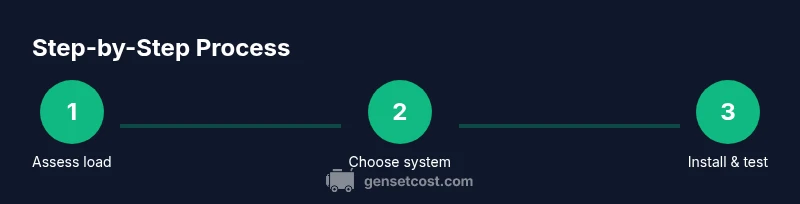
- 1
Assess loads and determine configuration
Start by listing essential circuits and calculating expected running loads. Decide whether you will use a portable setup with a transfer switch, or opt for a full standby system with an automatic transfer switch.
Tip: Keep a written list of essential circuits; it helps sizing and prevents overloading - 2
Obtain permits and engage a licensed electrician
Check local codes and apply for any required permits before work begins. A licensed electrician should review panel compatibility and safety considerations.
Tip: Permit delays are common; start early to align scheduling - 3
Select generator and transfer-switch solution
Choose between standby and portable units and confirm compatible transfer-switch options. Ensure the switch can handle your calculated load and matches your panel model.
Tip: Avoid undersized switches; better to slightly over-size within safe limits - 4
Install transfer switch or interlock kit at the panel
Mount the device adjacent to your main service panel per the manufacturer instructions. Follow wiring diagrams meticulously and keep conductors organized.
Tip: Turn off main service disconnect before starting; double-check with a tester - 5
Route generator power and secure connections
Run outdoor-rated conductors from the generator and route them through weatherproof enclosures to the switch or inlet. Avoid sharp bends and protect from physical damage.
Tip: Use proper strain relief and weatherproof fittings - 6
Make the final electrical connections and testing
Connect the generator to the switch or inlet according to the plan. With the main breaker OFF, perform a controlled test by energizing essential circuits one at a time.
Tip: Test with a helper and keep doors/windows open for ventilation - 7
Coordinate with the utility and schedule inspections
Inform the utility of the installation and schedule required inspections to ensure compliance and safety. Keep documentation on hand.
Tip: Utility procedures vary; follow their guidance to avoid interruptions - 8
Document maintenance and periodic testing
Create a maintenance calendar for the generator and transfer switch. Schedule annual or semi-annual tests to ensure readiness.
Tip: Record test results and service dates for future reference - 9
Review safety and user guidelines with household
Provide family members with basic operation procedures and safety rules. Ensure everyone understands how to safely start and stop the system.
Tip: Post emergency steps in a visible location
People Also Ask
Can I connect a generator to my house without a transfer switch?
Backfeeding through an outlet or wired directly into a panel is dangerous and often illegal. A transfer switch or interlock is required for safe operation.
Backfeeding is dangerous and often illegal; a transfer switch or interlock is required for safe operation.
What is backfeeding and why is it dangerous?
Backfeeding occurs when generator power flows back into utility lines, posing shock risks to workers and damaging equipment. Proper isolation prevents this.
Backfeeding sends power back onto the grid and can injure line workers; isolation is essential.
Do I need permits to install a generator connection?
Most jurisdictions require permits and inspections for generator connections to ensure safety and code compliance. Check with your local building department.
Permits are usually required and inspections follow installation to ensure safety.
Can I install a generator connection myself?
Electrical work can be dangerous and is usually best left to a licensed electrician. Some simple portable setups may be allowed with strict safety steps.
Electrical work can be dangerous; hire a licensed professional unless you’re following a strict, simplified portable setup.
How long does installation typically take?
Installation time varies with site conditions, permits, and panel compatibility. Plan for several hours of work plus any required inspections.
It usually takes several hours, due to wiring and inspections.
What is a realistic cost range for installation?
Costs vary based on generator type, switch, permits, and labor. Get a professional quote for a clear range.
Costs vary; get a professional quote for a clear range.
Watch Video
Key Takeaways
- Plan loads before purchase and sizing.
- Use a transfer switch or interlock for safe operation.
- Hire a licensed electrician for installation and permits.
- Test the system regularly and keep records.
- Maintain clear documentation for utility inspections.